Course Description
Most self-defense problems do not begin with the fight.
They begin earlier—with someone closing distance, controlling your attention, testing a boundary, blocking your path, using a bad angle, or creating pressure before you fully recognize what is happening.
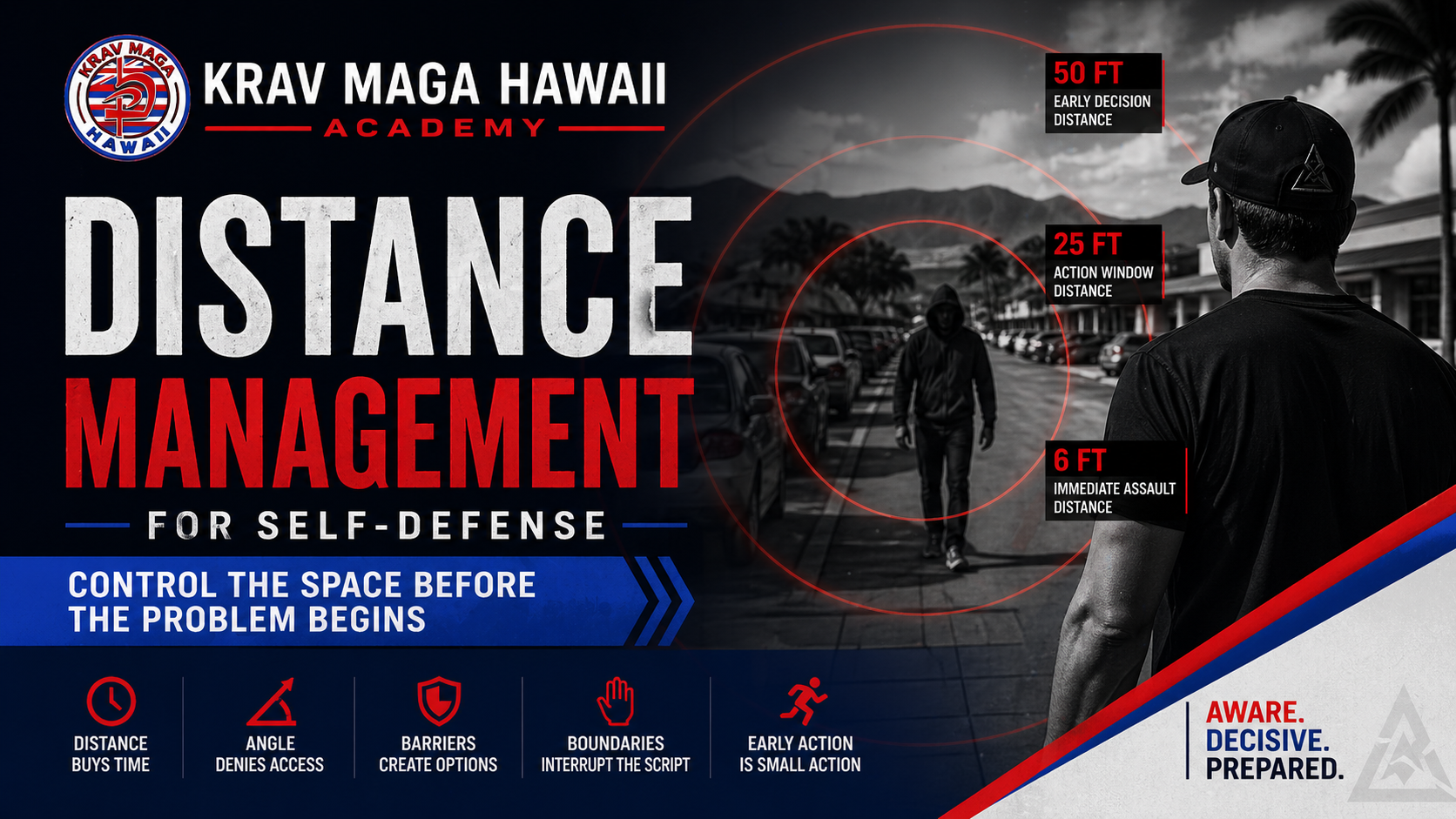
Distance Management for Self-Defense teaches you how to control space before a confrontation becomes physical.
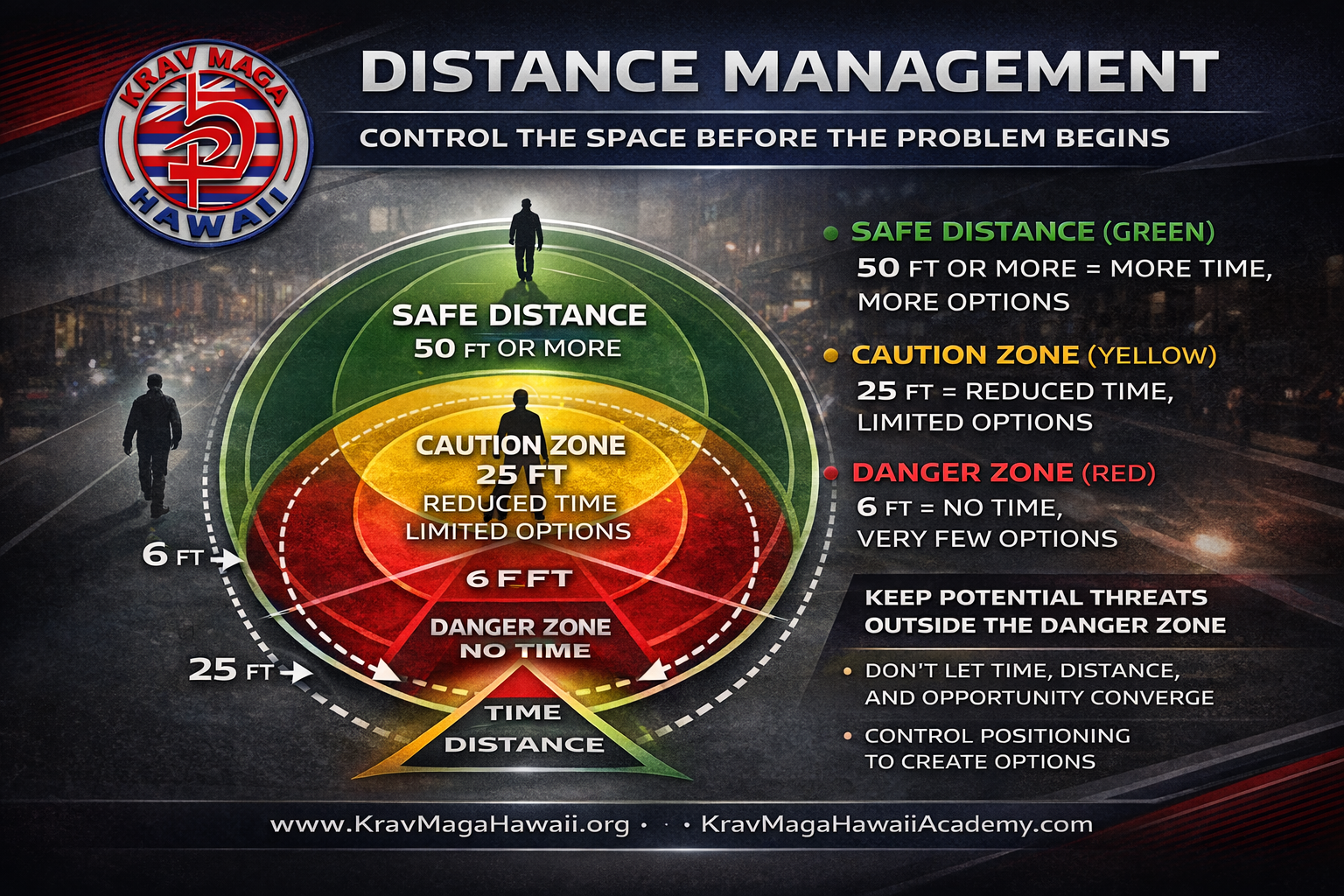
In this short course, you will learn how distance buys time, how angle denies access, how barriers create options, how hands reveal danger, and how verbal boundaries help interrupt unwanted contact. You will also learn the KMH 50 / 25 / 6 Distance Model and the Time–Distance–Opportunity framework so you can recognize when risk is increasing and take small, defensible actions earlier.
This course is not about paranoia.
It is about clarity, positioning, and practical decision-making.
Distance Management for Self-Defense
Control the Space Before the Problem Begins
Learn how to manage distance, angle, barriers, boundaries, and opportunity before a confrontation becomes physical.
Start Learning
Practical self-defense decision-making for everyday people, Krav Maga students, parents, security professionals, and responsible armed citizens.
What You Will Learn
By the end of this course, you will be able to:
- recognize when someone is unnecessarily closing distance
- use the 50 / 25 / 6 model as a practical distance-awareness tool
- understand how time, distance, and opportunity affect risk
- use barriers, angles, and movement to preserve options
- set simple verbal boundaries without escalating
- understand why hands matter more as distance decreases
- apply distance-management principles in parking lots, gas stations, checkout lines, public spaces, family movement, security work, and armed-citizen scenarios
Who This Is For
This course is for beginner Krav Maga students, everyday citizens, parents and protectors, responsible armed citizens, security professionals, and executive protection practitioners who want a practical framework for managing distance, reducing risk, and making better decisions under pressure.
What You’ll Get
Inside this course, you will get:
- the KMH 50 / 25 / 6 Distance Model
- the Time–Distance–Opportunity framework
- practical boundary-setting language
- hands, angle, and access recognition
- barrier and movement principles
- Red Zone close-range survival concepts
- real-world scenario applications
- downloadable worksheet, scenario practice sheet
Course Curriculum
Start Here
Lesson 0: How to Use This Course
Module 1: Distance Is Decision Time
Lesson 1: What Distance Management Really Means
Lesson 2: The 50 / 25 / 6 Distance Model
Module 1 Summary: Distance Is Decision Time
Module 2: Managing the Approach
Lesson 3: Unknown Contacts and Boundary Setting
Lesson 4: Hands, Angle, and Access
Module 2 Summary: Managing the Approach
Module 3: Controlling the Conditions
Lesson 5: Time–Distance–Opportunity
Lesson 6: Angles, Barriers, and Movement
Module 3 Summary: Controlling the Conditions
Module 4: When Distance Fails
Lesson 7: The Red Zone — Contact Range Survival
Lesson 8: Applied Scenarios for Armed and Unarmed Self-Defense
Module 4 Summary: When Distance Fails
Final Section
Final Course Summary
Downloads and Practice Resources
Glossary of Terms
Resources for Further Learning and Acknowledgements
Example Featured Products
Showcase other available courses, bundles, and coaching products you’re selling with the Featured Products block to provide alternatives to visitors who may not be interested in this specific product.